

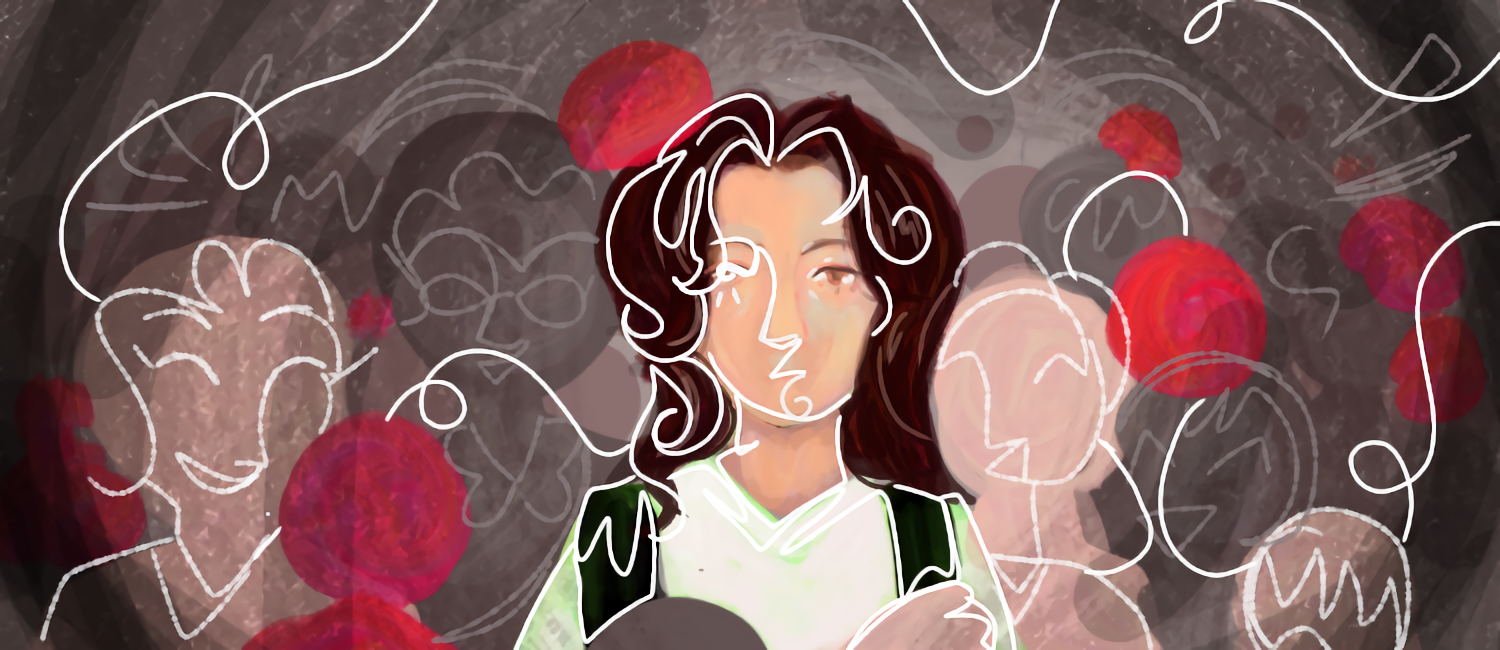
Artwork by Anoushka
Nashita Nur, The Hong Kong Polytechnic University
An international student crosses oceans to find her future, but must swim against the cultural tides that isolate the islands of campus life.
Lost in Translation: Language Barriers Reshaping Social Identities
By Nashita Nur
My extroverted self bounded toward the classroom. These were the final few steps toward the realisation of my long-held dream to study at an international university. Laughter and animated conversations echoed up and down the hallway, fueling my anticipation. But as I drew closer, a perplexing silence seemed to greet me. The voices were just as loud, the energy just as palpable, yet as I stepped into the room, I realised I couldn’t comprehend anything being said—not a single word.
The cacophony of foreign sounds closed in on me, forming an impenetrable bubble.
Despite the language difference, my enthusiasm remained undeterred. After all, I had travelled a long road to get here, to connect, to make friends, and to find my place in this new world. My talkative nature fueled my attempts to reach out, make jokes, ask questions, and show a keen interest in the cultural diversity of my peers. However, the reciprocity I sought was missing. The energy I expended in conversations often met polite yet distant smiles or brief replies before heads would turn back to continue chatting behind the local language wall, which I couldn’t breach. The vision of a vibrant social life slowly turned out to be a mirage. My voice was unheard, and my existence unseen.
– My voice was unheard, my existence unseen –
The effects of the language barrier I was facing socially spilt over into the realm of academics. In my experience, group projects were a recipe for disaster—an unintended storm, where my usually high grades were taking a nosedive. Students, already champions at procrastination and always racing the clock in a last-minute dash to the finish line, don’t really need another hurdle. Adding a communication gap to collaborative projects is basically like scripting our own blockbuster disaster movie, just without the popcorn.
As one disappointing day followed another, a quiet storm of questions formed. In the heart of Hong Kong, a city buzzing with constant activity and networking, how can the extroverts handle the sudden quiet that comes with language barriers? How can universities in Hong Kong truly fulfil their promise of being international when non-native speakers struggle to integrate socially? And perhaps most worrisome was the question of how I would survive this shift to the social sidelines within my own school.
Facing a lack of answers, I banged out my frustration into the keystrokes of this article as my thoughts drifted back to where the dream-reality disconnect began, back all the way to Bangladesh.
“Do you have any final questions?” Those were the words that my counsellor posed at the end of my interview for university admission. They still echo in my ears.
I asked, “Do I need to learn Mandarin or Cantonese?”
With a firm shake of the head, the advisor assured me that language would be no barrier in my upcoming academic journey.
The reality of this promise unfolded quite differently when, after a month of unnecessary quarantine, I finally stepped into a classroom, only to find myself an unwitting solo act in a play where everyone else had a different script. I had been informed that my cohort comprised “17 international students.” What wasn’t mentioned was that 16 of them were from mainland China. A simple heads-up during the interview would have been invaluable. The irony of the situation was almost comedic—a solitary figure in a crowd, thinking, “Did someone misspell ‘international’ as ‘intranational’ where ‘nation’ equals China?”
Just as I was about to resign myself to a lonely academic life, a ray of light pierced the storm clouds. I received a lunch invitation from those few individuals whom I knew could speak English. I was hopeful that English was back on the menu. However, as we ate, they chattered away in Cantonese. I faded again into a background character, silently nibbling my meal while their world of shared jokes and cultural references moved on without me. When the cameras all flashed for a group snapshot, I joked to myself ruefully: “I cannot add diversity to their conversations, but at least I’m here to add diversity to their photos!”
I didn’t blame my university peers for my isolation. It was my choice to come here, and they were facing communication challenges of their own.
Ken Liu, in his exploration of why Hongkongers hesitate to speak English, suggests a deep-rooted linguistic timidity. “It’s not just about speaking English; it’s about the fear of not speaking it perfectly,” he notes.
This insight resonated with me deeply, as I observed that my classmates’ fluent course presentations in English starkly contrasted with their reluctance to engage in casual English banter. It seemed the fear of making mistakes in informal settings was a stronger force than the necessity of communication with an outsider.
Having invested significant effort in mastering English to thrive in this so-called international milieu, I felt a deep sense of betrayal. The linguistic skills I honed through uncountable English lessons and movies to bridge cultural divides seemed futile. This realisation amplified my sense of isolation rather than alleviating it.
The loneliness became overwhelming, pushing me to seek counselling and medical support to cope with the stress. I confessed to my counsellor that “It’s like everyone’s speaking, but no one’s really communicating.” My academic advisor’s suggestion to “Just learn some Chinese; it will help you to make friends” felt dismissive, underscoring a lack of institutional support.
– Everyone’s speaking, but no one’s really communicating –
The emotional low point of my life arrived alongside a profound personal tragedy—the loss of my father. I had to muster all my courage to return to normal life, and I hoped for even a small measure of warmth from my peers. This expectation, I believed, was not unreasonable. Yet, upon my return, I was met with nothing but a cold insistence on academic productivity from my peers, pushing me to meet group deadlines with no regard for my recent ordeal. This reception shattered any last illusions of support, prompting me to withdraw my efforts to connect.
I resolved then to face my challenges alone; I decided to fight and win the battle on my own terms. Instead of relying on reluctant teammates or expecting external solutions, I began treating group projects as if they were my own. I took on the lion’s share of the work to ensure quality and protect my academic standing, which was essential if I was to retain my scholarship—and my sanity.
As I struggled on, I discovered that my personal narrative reflected a global challenge identified by UNESCO. Approximately 40% of students worldwide face educational barriers due to a mismatch between their native language and the language of instruction. This gap can lead to underestimated abilities and academic disparities, particularly in group settings where communication is crucial. I found some comfort knowing that I wasn’t alone in my loneliness.
While navigating the academic and social maze at university amid cultural displacement can often feel like a solo expedition, it is reassuring how some compassionate people pop up like guardian angels to provide companionship. Perhaps we need more people like Bob and Charlotte, two English-speaking film protagonists who help each other as they stumble together through an isolationist culture in Asia.
But we can’t just rely on the grace of movie-like characters to alleviate the challenges students face in faux international programs. As we look forward, it is imperative for universities like PolyU to sincerely embrace their international ethos. Concrete steps could include mandating and facilitating peer language-buddy systems and offering structured support groups for incoming international students. Students should also be actively encouraged, and even rewarded, to step further out of their social comfort zones.
By taking such steps, we may transform the silence of the language divide into a chorus of inclusivity, where every voice is heard, every heart is seen, and no one is lost in translation.

About the Author
Nashita is an international student from Bangladesh and studying biomedical engineering. When not in the lab, she volunteers with special needs learners and reads sci-fi and fantasy novels. This socially inclined undergraduate also enjoys dancing and traveling. Nashita plans to apply her degree and outgoing personality to roles in sales or R&D in the medical field.
Author’s Reflection
This article began as an ELC2011 assignment in my final year at PolyU—an opportunity I knew I couldn’t waste to finally tell my story. Previously, I had always been scared to speak up, worried about judgment or sounding ungrateful to a university that gave me a platform. I also didn’t want to look disrespectful towards those people who always tried to support me during this academic journey. My professor’s assurance that I was free to speak my mind gave me the courage to pour my unfiltered emotions onto the page. The encouragement and appreciation I received after winning first prize in the CILL Feature Article Competition was something I never could have imagined.
The writing and editing process was a journey in itself. The feedback from my editors was invaluable, pushing me to refine my language, add vivid detail, and navigate the delicate balance between personal vulnerability and broader observation. Looking back, I wish I had pushed myself further out of my comfort zone earlier, to better understand other perspectives even while navigating my own grief. This piece, for me, is more than an assignment; it is a marker of my growth, not just as a writer finding my voice in a third language, but as a person learning to advocate for my own experience.