

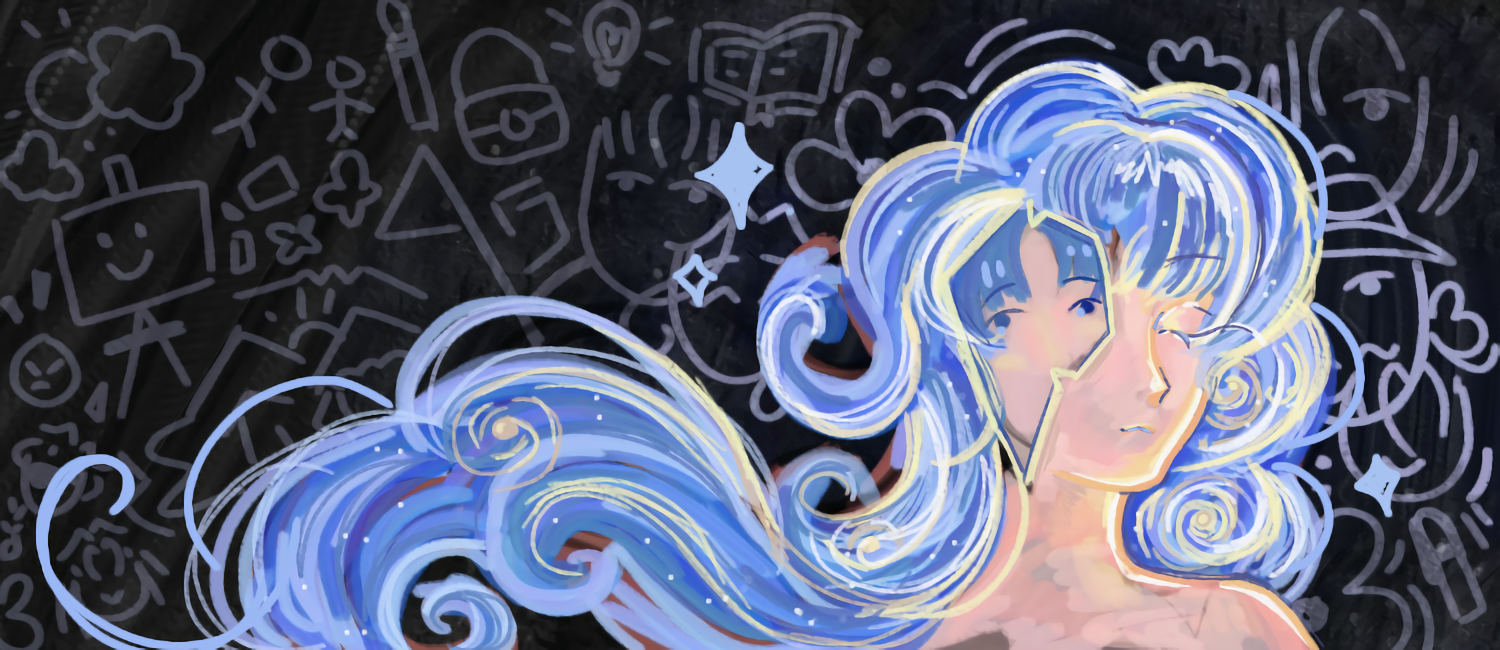
Artwork by Anoushka
Duan Jie, The Hong Kong Polytechnic University
Walk in the footsteps of Jie as she invites you to step out of the shallows of your mind and wade into the beautiful depths of truth.
Do We Oversimplify Art the Same Way We Oversimplify People?
By Duan Jie
Foreword
Approximately 10,000 years ago, we Homo sapiens—cold, naked, and afraid—left the relative safety of our caves, with their walls covered in crude paint and chalk. We set out to explore our world and, ultimately, ourselves. As the last ice age retreated, we advanced, both in art and cognitive complexity.
Yet, today, we postmodern beings find renewed comfort in simplicity. But at what cost?
Back into the Cave
“Art is all a matter of personality.” — Marcel Duchamp
As I entered the Hong Kong Museum of Art for the first time, I was struck by how starkly the hushed, dimly lit modern spaces contrasted with the bustle of Tsim Sha Tsui just outside its walls.
I strolled to the reason for my visit, the “Art Personalized” exhibit, where I was immediately invited to take a 12-question personality test. Apparently, this would determine which section of the four-part exhibit I would be best suited to visit: Adventurer, Perfectionist, Elegance, or Fashionista?
The results came back quickly.
Adventurer? Really?
With a shrug, I headed toward the Adventurer zone to examine the artwork, which was said to be “just like me.”
Adventurer
“In art, to rebel against an inherited tradition is an arduous creative process.”— Wu Guanzhong
The first piece to greet me was Forest of Old Trees (1996), followed by Patchwork (2009). Both paintings are by Wu Guanzhong, a pioneer in modern Chinese art known for blending Chinese ink traditions with Western oil techniques. His work reflects a spirit of exploration—something the museum associates with “adventure.”
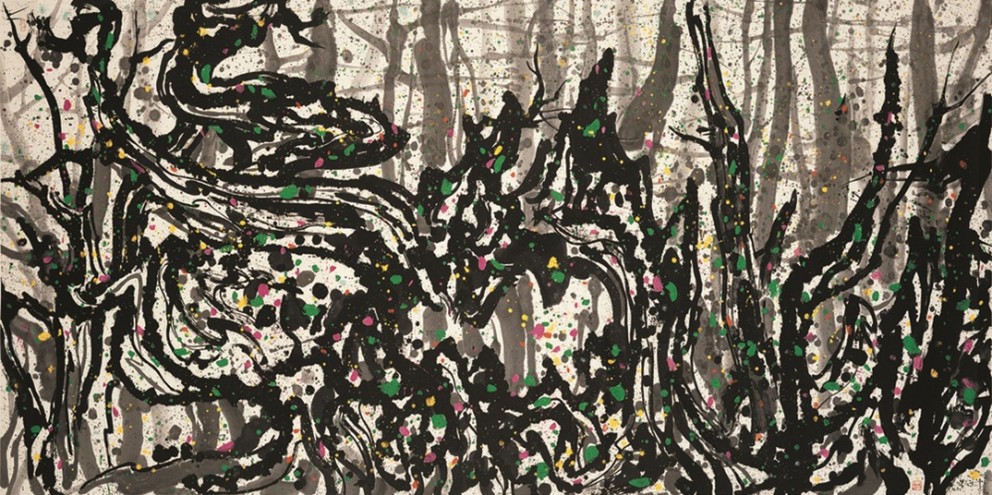
In Forest of Old Trees, he paints trees like rivers. It’s like using cursive script, I thought, instead of regular block style to express ideas. It may not have looked like a forest, but it felt like one.
In traditional ink painting, there are normally only two colours: black and white. But when I stepped closer to the dark, quiet, and even sad-looking forest, I noticed colourful dots—pink, yellow, and green—as if they had just jumped out from behind the trees.
“I see you,” I whispered to the little dots.
I shifted over to Patchwork, in which Wu uses blocks of colour to replace figurative forms. Though abstract in appearance at first glance, a deeper investigation reveals how the painting conveys the Chinese folk spirit. Patchwork symbolises the clothing worn by China’s poor. When their clothes are torn, they mend them by sewing in patches of fabric in various colours.
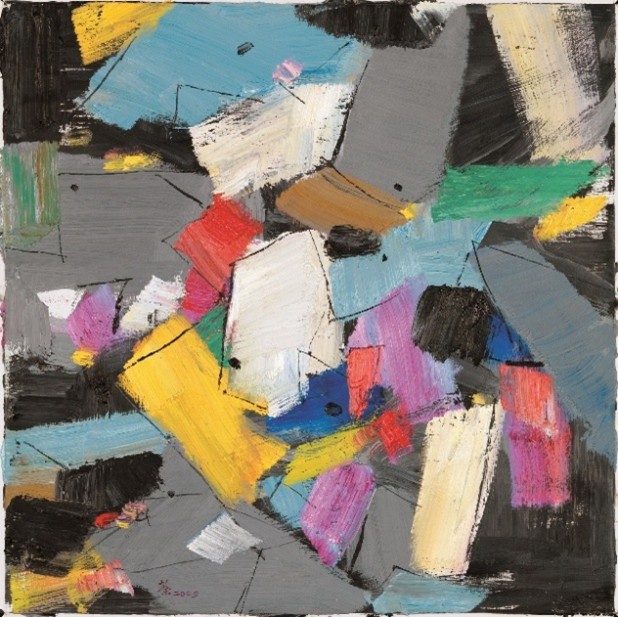
I smiled at the subtle cleverness of the painter; every colourful block was a patch, and every brushstroke was a stitch. Wu is mending our fabric.
Taken together, these two works of art suggest a bold form of “adventure,” making them a natural fit for this section.
Elegance
“Everything has beauty, but not everyone sees it.” — Confucius
As I entered the Elegance zone, The Footprints of Bai Juyi (2013) appeared ahead. Inspired by the Tang dynasty poet Bai Juyi, Pang Jun paints not his literal footsteps, but the quiet, poetic spirit he left behind. Although placed in the Elegance section, the painting suggests something more—it is also a challenge. After all, isn’t facing a challenge with grace the true test of elegance? If so, the challenge in this section was to express a Chinese poetic sensibility through Western oil painting. Just like Wu Guanzhong, Pang Jun uses Western oil to paint the East.
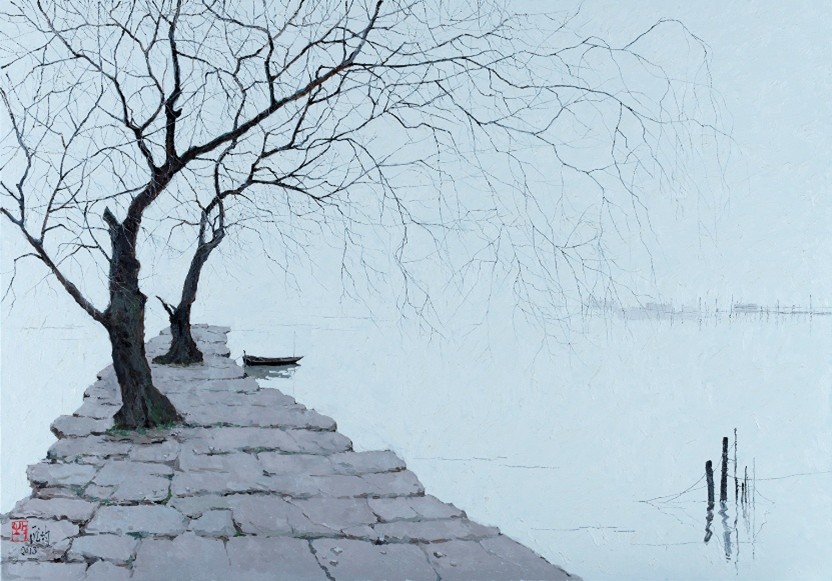
The fact that the artists were slotted in their respective zones may be due to the curators’ view of “challenge.” Perhaps they preferred to highlight the outward revolutionary challenge, while downplaying the inward spiritual challenge. However, from my point of view, Pang Jun’s choice to remain still and inward-looking in this contemporary era that celebrates innovation and disruption is, in itself, a quiet rebellion.
My thoughts turned to the quiet hues of this work. Oil paintings are often associated with bright, vibrant colours. However, Pang utilizes a muted tone with black, grey, and white. It is a challenge of temperament.
Fashionista
“In order to be irreplaceable, one must always be different. — Coco Chanel”
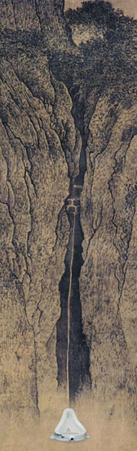
The opening painting in the Fashionista zone is Fountain: Fan Kuan vs Duchamp (2000) by Zhang Wei. Instead of painting it himself, he uses digital printing to combine two existing paintings. He places Fan Kuan’s Travelers Among Mountains and Streams in the background. At the bottom of the foreground, he situates Duchamp’s infamous Fountain, which is a urinal offered up by Duchamp as art. The irreverent juxtaposition of a sacred landscape with a urinal aims to question the notion of what art is. And by using digital printing to combine existing works together, he further questions the worship of an original “masterpiece.”
Although this work was placed in the Fashionista section, I believe it truly belongs to the Adventurer zone. This work is not about fashion as it appears on its surface, but about rebellion. It is a playful yet bold challenge that seems to almost literally piss on artistic hierarchies.
I suddenly felt the need to visit the bathroom, where I could better focus and summarise my stream of thought.
Comfort’s Cost
Like humans, this exhibition assigned complex pieces of art to four simple personality archetypes: Adventurer, Elegance, Fashionista, and Perfectionist. But like humans, I think works of art also have multifaceted personalities. Why can’t paintings be fashionable but challenging or elegant but rebellious? To me, dividing artwork into four simple archetypes may be a misunderstanding that overlooks the inner personality of each individual piece. While this exhibition is visually appealing, I think it oversimplifies what is, and should be, beautifully complex.
If art is complex, then the human mind and the personalities it forms are near unfathomable. However, we Homo sapiens like our world to be neat and orderly. So, we created multiple ways to categorise ourselves and others, including zodiac signs and blood types. How comforting! But isn’t it, just like our treatment of art, a paint-by-numbers oversimplification?
Many of my friends have relied on the Myers-Briggs Type Indicator (MBTI) for guidance on who they are—which of the 16 boxes they correctly fit into. This may be one small step above the voodoo of astrology and blood types in terms of possible validity. However, a careful analysis suggests that the MBTI is neither predictive nor reliable, and its dichotomies are an oversimplification of personality, which doesn’t account for such complexities as the context-specific characteristics of human behaviour and emotion.
Ironically, after taking the test, we might see less of who we are and can be, not more.
I checked my watch and realised I was already late for my class. I made a note to return tomorrow to finish my investigation. I also guessed that my teacher wouldn’t believe I had lost track of time—I’m always a “punctual perfectionist.”
Sure, just not today, I smiled.
As I left the cavernous museum behind and walked into the daylight, I felt glad that I hadn’t limited myself to only the Adventurer section nor placed too much emphasis on all the labels that make paintings—and people—seemingly easy to understand.
Oversimplification, after all, can blind us to the mysterious canvases of art and humanity, leaving us staring at the shadows on the cave wall, rather than the light outside.

About the Author
Duan Jie is a fourth-year biology student at PolyU.
Author’s Reflection
This piece originates from an elective art course I took last semester, Appreciation of Chinese Art and Design. It required that I visit an art exhibition, which was my first time. The original structure was more of an essay. However, with the help of an editor, I added some personal, “human” colouring.
I think humans and art are somewhat alike in that they’re both being watched and interpreted. Sometimes, maybe often, the interpretation is wrong. And if works of art have feelings, they may also sense unfairness when critical eyes are not seeing clearly.