ILAC 2009
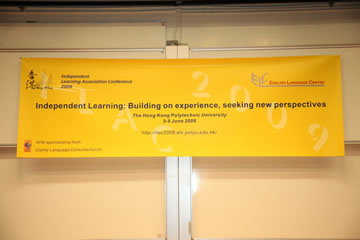
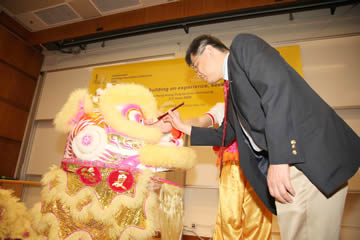
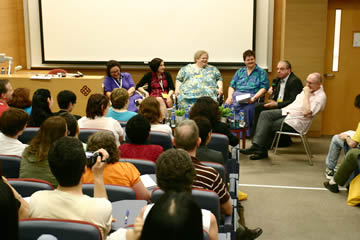
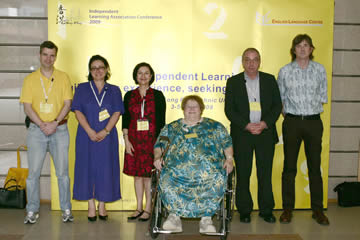
The ELC jointly hosted The Independent Learning Association Conference 2009 at PolyU from 3 - 5 June 2009. The gods smiled on the conference, as it happened just at the right time between the first cases of swine flu in HK and the sudden increase later in the month. A number of Mexican and Japanese presenters did, unfortunately, have to drop out, but over 100 papers were presented to over 300 participants over the 3 days by presenters from 26 countries around the world.
 |
 |
 |
 |
The main conference theme was 'Independent Learning: Building on experience, seeking new perspectives', and the most popular sub-theme was ‘e-learning initiatives’ which attracted nearly a fifth of the papers. You are welcome to visit the conference website at http://ilac2009.elc.polyu.edu.hk, where you can see all the paper titles and abstracts. A number of ELC staff presented papers at the conference and their papers are summarised below.
Many thanks to the ELC’s administrative and technical staff, who made the event so successful, and we look forward to holding more conferences in future.
Andy Morrall
ILAC Co-ordinator
In her paper "ePortfolios for independent language learning: episodic innovation or lasting reform?" ELC Lecturer, Juliana Chau, addressed some of the questions frequently raised about the research on ePortfolios, that users may view ePortfolios as a one-shot endeavour rather than a device of lasting usefulness.
Because of the relative novelty of information and technologies (ICTs) in learning, there is also debate about whether ePortfolio users are ‘learning about technology’ or ‘learning through technology’. Learners who are ICT literate may not be academically e-literate, and consequently lack the necessary skills to make appropriate use of technology to permit effective learning to occur.
Her paper discussed the findings of her ePortfolio project which develops English skills and learning communities at PolyU. The study aimed to investigate teachers’ and students’ perceptions of ePortfolios from three perspectives: linguistic (relationship between ePortfolio, language learning and learning community), technical (the extent to which technology helps or hinders ePortfolio use), and referential (meaning of ePortfolio with respect to self and community).
Participants included 250 students and 17 teachers involved in several PolyU English language courses between 2007 and 2008. Students were asked to identify the purpose of their ePortfolio, collect artifacts, showcase their best work, and make connections between themselves and the community as a student, a member of the community and a beginning professional. Questionnaires and focus group interviews were conducted to solicit feedback from students and teachers.
The findings of this paper suggested differing perceptions of the ePortfolio between teachers and students, which in turn affected their attitude and level of engagement. This carries implications for practitioners using ePortfolios for developing learner independence and language competence.
Juliana, along with ELC colleague, Peggy Lui, followed up the paper presentation with a practical workshop entitled, The what and how of using ePortfolios for language learning.
The workshop introduced participants to the ePortfolio system that the ELC has devised and implemented to help students develop greater proficiency in English and for professional employment. The workshop comprised two sections: learning about the main features of the ePortfolio system (‘what’) and engaging in hands-on activities (‘how’). Participants also took part in a discussion with the facilitators about issues pertaining to ePortfolio development and implementation from the perspectives of the teacher, learner and system designer.
Juliana Chau
ePortfolio Co-ordinator
GSLPA Poster Presentation
The Graduating Students' Language Proficiency Assessment is a suite of language tests in English and Chinese that are compulsory graduation requirements for PolyU students. Though there is no requirement to attain a particular score on the assessments, it is the University's hope that students will take advantage of the resources available to them throughout their course to improve their language skills. These resources include both taught programmes and self-access language learning. Students can prepare for the GSLPA (English) tests by attending preparation workshops or through self-access learning. The ELC of the University provides a GSLPA Learning Package that students can use in the CILL or online from the GSLPA (English) website.
Through this e-poster, Alan Urmston and Felicia Fang, the GSLPA (English) Co-ordinator and Projects Manager illustrated how the Learning Package and other resources have been designed to meet the demands of students eager for test preparation. They engaged in fruitful discussion with colleagues on the whole issue of self-access language test preparation.
Felicia Fang
GSLPA (English) Projects Manager
"Goodpoint!" workshop
In this workshop participants were introduced to "Good Point!" an online program developed by Andrew Morrall, ELC Senior Lecturer, that aims to develop students' critical thinking skills. They discuss and share their ideas about university and current affairs topics in order to help them formulate their own arguments. However, this is not done in the traditional way by writing arguments in prose, but in a more systematic, interactive way, namely, through presenting their ideas as points in discussions, which are then viewable in a variety of ways, including as lists of points, tables of pros and cons, topic maps or slideshows.
"Goodpoint!", which is available at http://goodpoint.elc.polyu.edu.hk, was explained and demonstrated. Participants were then given the opportunity to use the program to post their own discussion topic, comment on other participants' topics and evaluate them. They were then able to use these topics and comments to construct an academic essay or presentation, using the program’s essay and presentation planners.
The PowerPoint for the workshop is available here.
Andy Morrall
ELC IT Co-ordinator
E-learning initiatives in ELC: Pedagogy, Technology and Culture
Successful e-learning is where learners emerge as effective participants, at home in a technology that is designed to meet organizational, pedagogical and human evolutionary needs. So how does an e-learner, become a citizen at home in an effective online community? In this paper, we were less interested in e-learning as a learning support or administration system than e-learning as a complete ecological system where humans and computers interact.
In the paper we described our aim to develop a systems model of e-learning initiatives where learners emerge in an online eco-system that can be built by conventional learning institutions such as the ELC. We suggested a dynamical model for e-learning where three learning context dimensions, the pedagogical, technical and cultural, work as one socio-cognitive process. In this way we sought a systems description of e-learning as a learning activity where both humans and technology evolve to produce effective learners who succeed in an online community of learners.
Alfred Lee and Voyce Li
Language Instructor and Computer System Officer